KB vs RAG: What Your Company Actually Needs
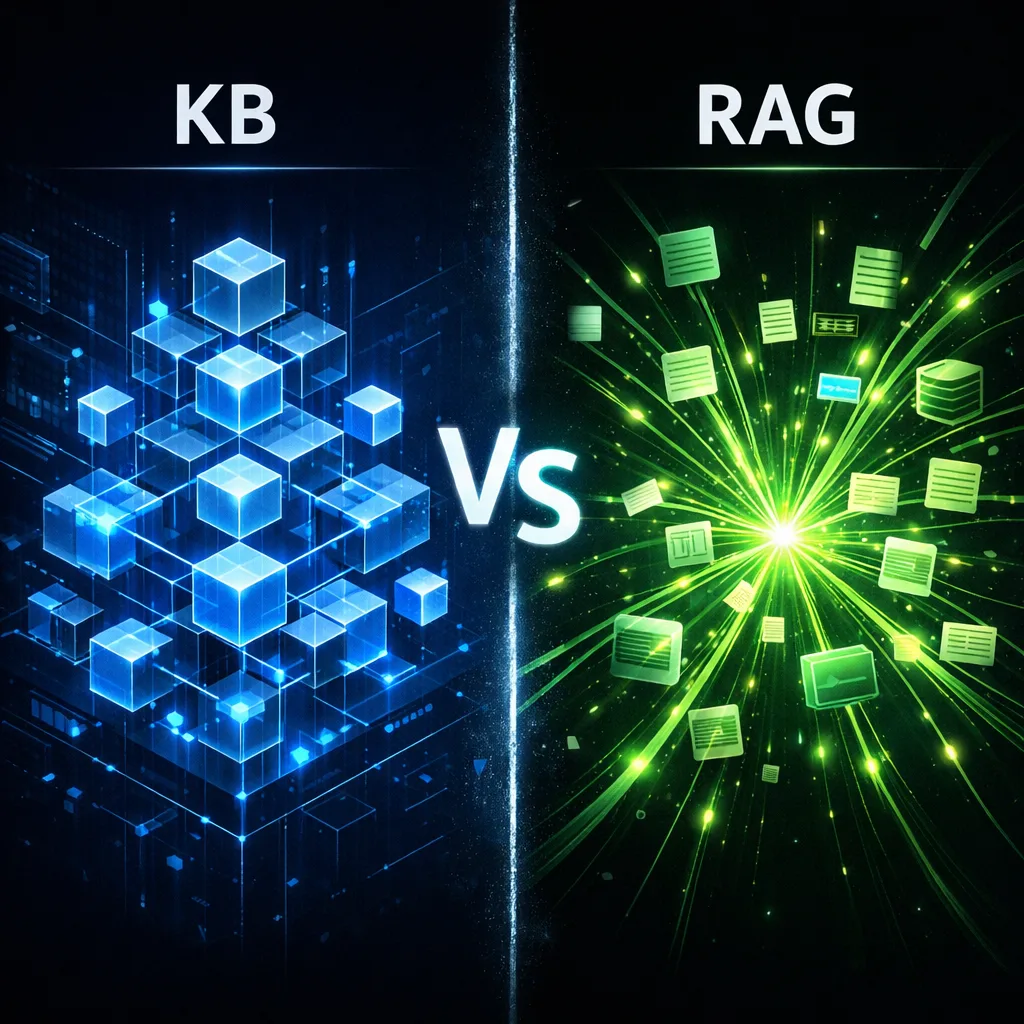
Every week we hear from companies that say “we need RAG” when what they actually need is a structured knowledge base. These are fundamentally different approaches, and choosing wrong can cost you months and tens of thousands of dollars.
Let’s break down the real differences — no hype, just architecture.
What Is a Knowledge Base (KB)?
A knowledge base is a structured collection of your company’s knowledge — documents, processes, pricing, templates, SOPs — organized so both humans and AI can find and use them instantly.
Think of it as your company’s brain, properly indexed. When an employee asks “what’s our pricing for CLT panels in the EU market?”, the AI reads the actual pricing document and gives an accurate answer.
Key characteristics:
- Curated, structured content your team controls
- AI reads documents directly (no embedding, no vector math)
- Works with Claude Projects, Custom GPTs, or any LLM with file access
- Updates are instant — edit a doc, AI sees the change
- Typical setup: 2-4 weeks
What Is RAG (Retrieval-Augmented Generation)?
RAG adds a retrieval layer between your data and the AI. Your documents get chunked, embedded into vectors, stored in a vector database, and when someone asks a question, the system searches for relevant chunks and feeds them to the LLM.
Key characteristics:
- Automated pipeline: ingest → chunk → embed → store → retrieve → generate
- Handles massive datasets (10,000+ documents)
- Requires infrastructure: vector DB, embedding model, retrieval pipeline
- Updates require re-indexing
- Typical setup: 8-16 weeks
The Real Comparison
| Factor | Knowledge Base | RAG |
|---|---|---|
| Setup time | 2-4 weeks | 8-16 weeks |
| Cost | $3K-20K | $30K-150K+ |
| Best for | 50-500 documents | 5,000+ documents |
| Accuracy | Very high (curated content) | Variable (depends on chunking & retrieval) |
| Maintenance | Edit docs directly | Re-index pipeline |
| Infrastructure | Google Drive + Claude/GPT | Vector DB + embeddings + custom code |
| Team needed | 0 developers after setup | 1-2 developers ongoing |
When You Need KB (Most Companies)
You need a knowledge base when:
- Your company has 50-500 critical documents
- Information is scattered across 5+ platforms
- New hires take weeks to get productive
- Your team already uses (or wants to use) AI assistants
- You need accurate answers, not probabilistic ones
- Budget is under $50K
This covers roughly 80% of mid-market companies we talk to.
When You Actually Need RAG
RAG makes sense when:
- You have 5,000+ documents that change frequently
- You need semantic search across massive unstructured datasets
- You’re building a customer-facing product (not internal tool)
- You have engineering capacity to maintain the pipeline
- Accuracy trade-offs are acceptable for scale
Think legal firms with 50,000 case files, or SaaS companies embedding AI in their product.
The Dangerous Middle Ground
The most expensive mistake is building RAG when KB would suffice. We’ve seen companies spend $80K+ on RAG infrastructure for 200 documents that could have been structured in a knowledge base for $10K.
The failure rate for RAG projects is 40-60%. Not because RAG is bad technology — it’s because most companies don’t have the data volume or engineering capacity to justify it.
Our Recommendation
Start with KB. Always. Even if you think you’ll need RAG eventually:
- Build a structured KB first (2-4 weeks)
- Connect it to AI assistants via MCP
- Use it for 3-6 months
- If you genuinely outgrow it, migrate to RAG with clean, structured data
A well-built KB is the foundation for any future RAG implementation. Starting with RAG without structured data is like building a search engine for a messy warehouse.
The Numbers
From our experience building enterprise AI systems:
- KB projects: 2-4 weeks, 90%+ success rate
- RAG projects (industry average): 8-16 weeks, 40-60% failure rate
- Companies that built KB first, then upgraded to RAG: 95% success rate
The structured data from a KB phase makes everything downstream — including RAG — dramatically more reliable. For a step-by-step guide on building the KB foundation, see How to Structure Company Knowledge for AI.
Need help deciding? Start with our KB Audit & Strategy — it gives you a clear answer in 1-2 weeks. Or see the construction case study for how KB-first works in practice.