Selected documents
Start with an approved folder and an agreed list of questions.
AI search
Ask a question. Get an answer linked to the relevant passage in your documents.
Discuss this task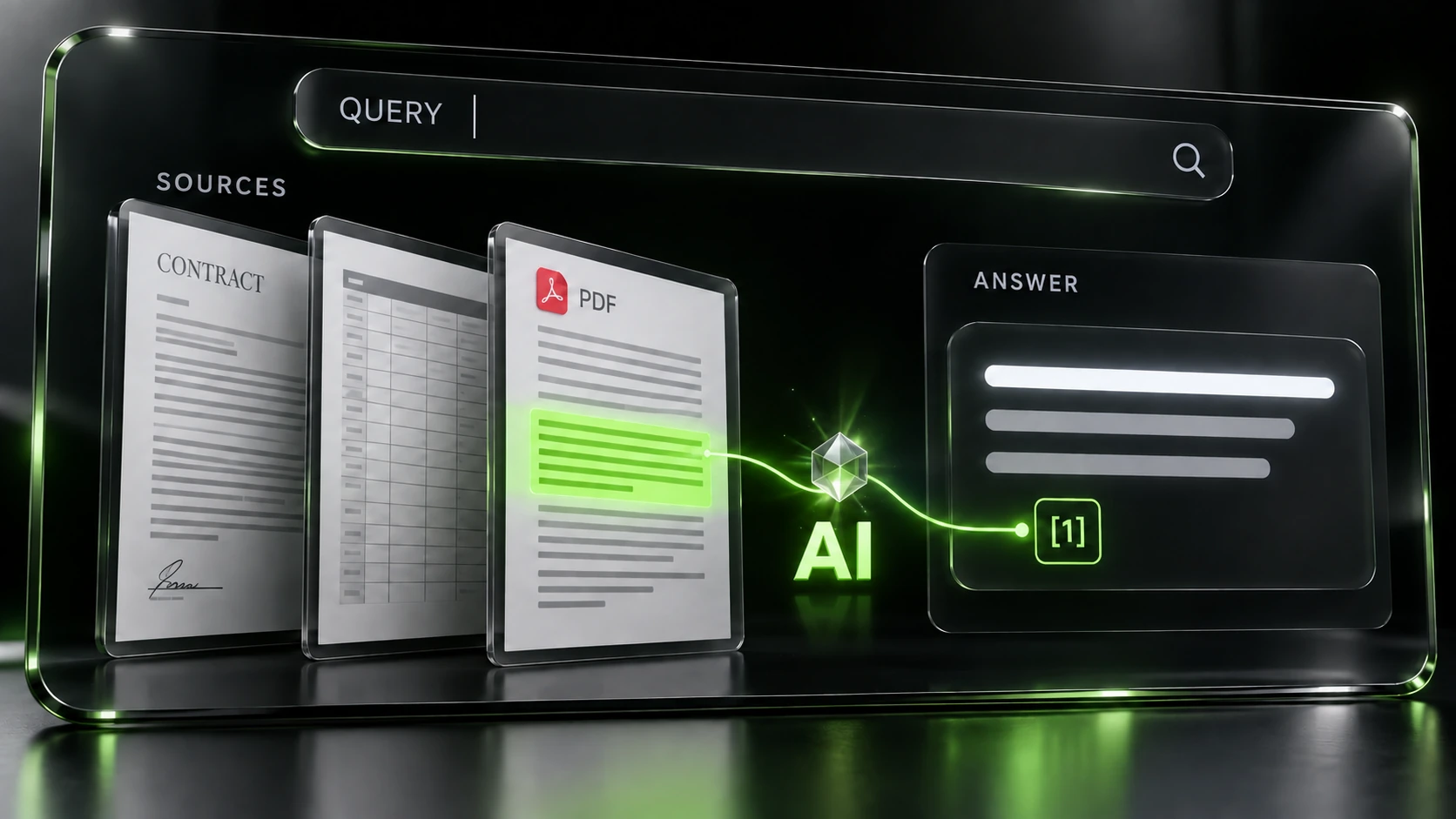
When a person takes over: If no submission window is stated, send the question to an owner
When a person takes over: If guide versions conflict, show them for review
When a person takes over: If no relevant material exists, do not invent an answer
Start with an approved folder and an agreed list of questions.
Clarify material groups, access rules and who keeps them current.
Plan search across your sources after reviewing formats and access.
Document search should help people with a work question, not just produce a plausible reply. The starting point is the information your team needs, the materials that may contain it and who is allowed to use them. Ordinary search may be enough.
A focused review can establish which parts of an agreed collection are usable, which versions apply and where information is missing or contradictory. You receive a source list, the limits of the review and a recommendation.
That recommendation might be to organize the documents, resolve a conflicting rule, improve ordinary search or try a pilot. This review does not build a search system or repair every document. If the materials and requirements are already clear, it can be skipped.
A pilot compares short answers with source links against the search you already use. It covers one topic, an approved document set and a defined group of readers. Someone who knows the subject checks whether the answers are supported, complete enough and useful.
You receive a working test version and the results of the checks, including failures. A link is not a guarantee: it must lead to the right passage and version. We also check missing information, conflicting sources and questions that need clarification. The comparison may show that keeping ordinary search is the better next step.
The starting version uses a dated snapshot, not live access to every document. If the job needs current operational information, that snapshot may be unsuitable. A company-wide rollout, additional sources and continued maintenance are separate decisions.
If teams or clients may see different materials, those limits need to be understood before exposing search results. A review can map the relevant readers, documents and rules for one task, including what happens when access changes.
The result is a proposed scope and checks, not an installed permission system. Limits must apply to excerpts and links as well as answers. An existing permission model is not assumed to work automatically in a new search tool.
“No supporting information found” is different from a source that could not be read. If documents disagree, someone responsible for the content needs to establish which rule applies. The system should not fill the gap with a guess or report a complete list from a few retrieved passages.
A note saying a person needs to review a question does not mean a review request has been sent. Any actual handoff needs its own agreed route.
We need to know who owns the content, how updates reach search and what happens when a document or permission is withdrawn. A fixed document set does not make access permanent. Where the information is processed and stored also needs to be agreed. Being allowed to read a document does not by itself allow uploading it to another service.
Tell us what your team is trying to find and where they look now. A description is enough for the first discussion; please do not send confidential documents. Any material needed for a later review can be arranged through an agreed process.
We can then define the useful first step, its cost and the people needed to check it. None of these options is a promise of error-free answers.
From materials you approve: documents, instructions or a knowledge base.
The workflow should mark the gap and send the question to a person instead of guessing.
That depends on your sources and access model, which need review during scoping.
That needs checking against the questions you want answered: which versions are current and whether the files, tables and scans can be read properly. Someone on your side needs to confirm the content.
The project needs a clear update process and a person responsible for it. Changing a file does not prove that search is using the new version, and removing it does not prove all copies have disappeared. If an essential update or permission cannot be confirmed, the affected answer should wait.
We agree what the solution needs to do, then check the actual version against that: you should be able to see what was tested, what worked and what still needs attention. A design concept shows an idea; a technical example only shows a tested result when tests were actually run, and neither replaces checks for your project. Accepting the work and putting it live are separate decisions.